Flash or update your board




THE PUZZLE WORKSHOP
Go beyond searching.
Understand.
Try the mathematics behind BitBeard yourself. Small examples show what happens during a search and why the size of the range matters.
01 / RANGE & PROBABILITY
How big is “big”?
Puzzle 10 contains 512 possible keys. Puzzle 71 already contains more than one sextillion. The calculation rate determines how many candidates can be checked each second.
Use any example speed here. It is not a performance claim for BitBeard or an FPGA.
Why two probabilities?
Without repeats, each candidate is checked at most once. Assuming a uniformly distributed target key, the probability of a match equals the fraction checked. Independent random attempts may repeat candidates: the probability is 1 − (1 − 1/N)^k. Even after N random attempts, it is about 63%, not 100%.
02 / MINI PUZZLE
A search you can see.
This learning puzzle has exactly 16 candidates, from 16 to 31. Each step calculates a real Bitcoin address and compares it with the target. The public example target belongs to the number 21.
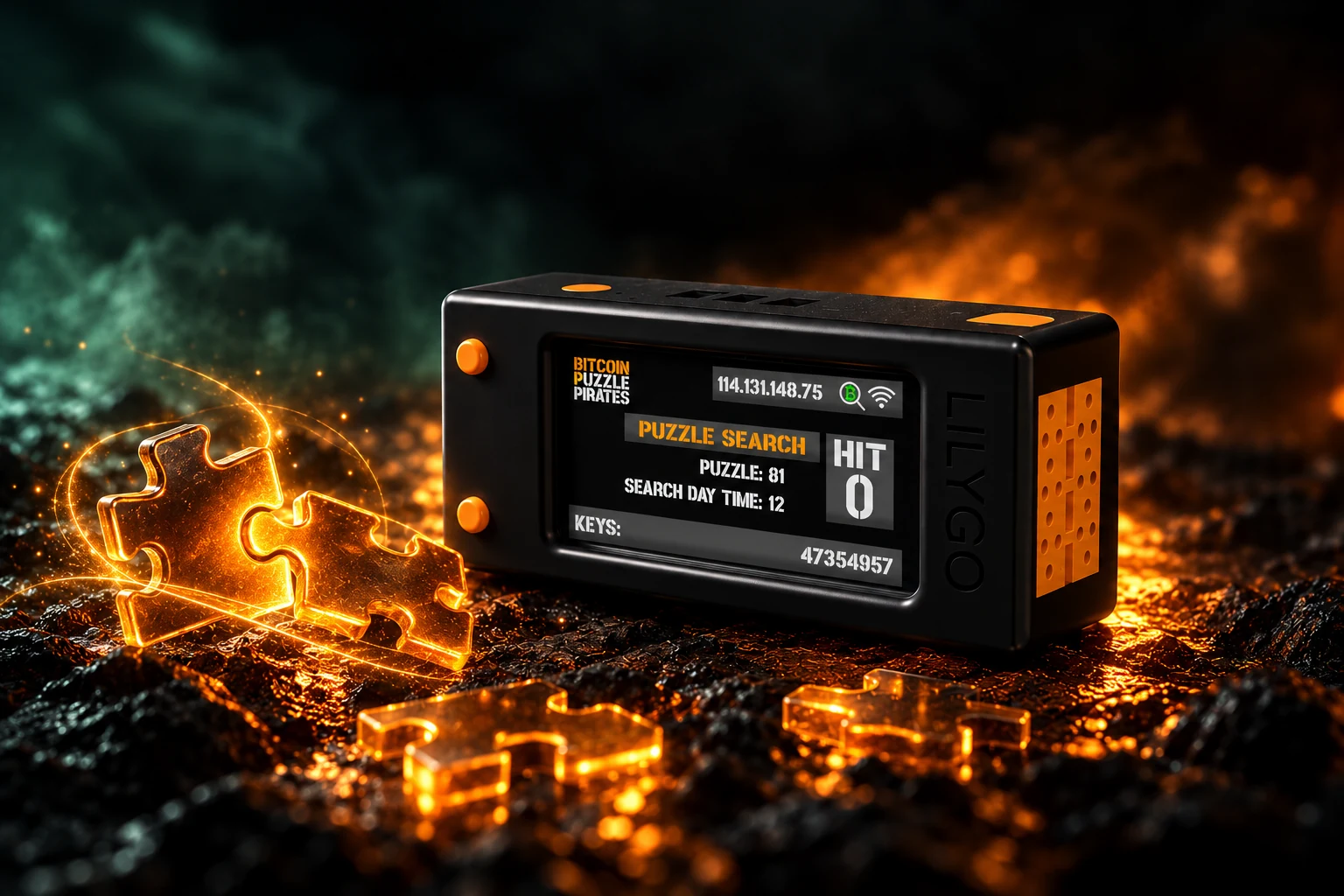
This is how the basic puzzle search works: choose a number, derive its address, compare. BitBeard continues this work independently and shows progress on its display.
TARGET ADDRESS
03 / KEY FORMATS
One number. Two formats.
HEX represents the key as a hexadecimal number. WIF packages the same key with a network prefix, an optional compression marker and a checksum. Compression concerns the public key, not the secret number.
Use public example values only. This learning tool is not a wallet. Conversion runs locally in your browser; inputs are not stored or transmitted.
FROM UNDERSTANDING TO YOUR OWN DEVICE
Your next step:
BitBeard.
Here you learn individual calculation steps. BitBeard turns them into a standalone search with a display and on-device controls. Pro adds pool, cluster and optional FPGA support to suit your setup.
The size of the search range remains decisive. More computing power does not guarantee a match or a return.